Yemeni Journal of Life Sciences Marks International Open Access Week 2026: “The Cost of Knowledge”
JOURNAL NEWS | OPEN ACCESS
Yemeni Journal of Life Sciences Announces Participation in International Open Access Week 2026The Cost of Knowledge
15 October 2026 | International Open Access Week: 19–25 October 2026
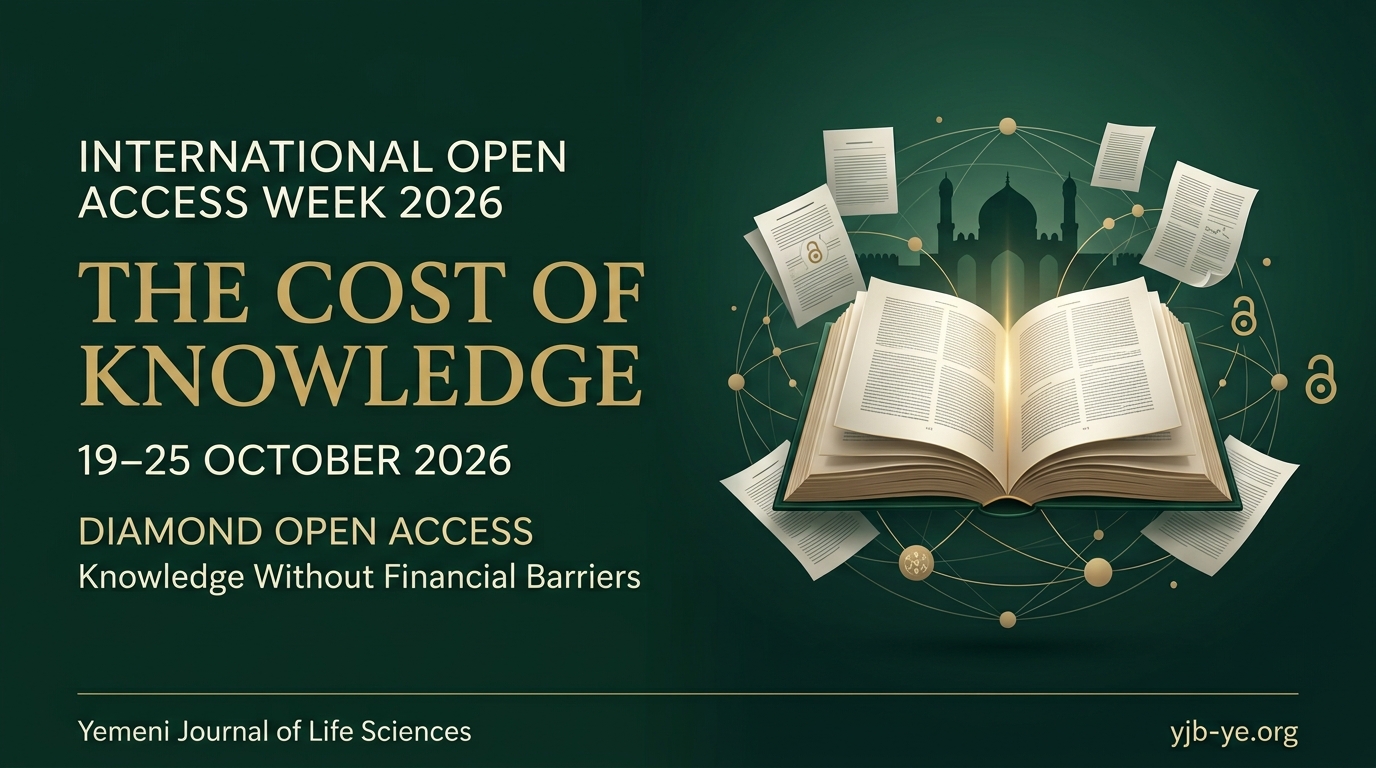
The Yemeni Journal of Life Sciences, published by the Forum of Yemeni Microbiologists, is pleased to announce its participation in International Open Access Week 2026, taking place from 19 to 25 October 2026 under the theme “The Cost of Knowledge.”
To mark the occasion, the journal is presenting a free, English-language, asynchronous online awareness initiative exploring the costs of scholarly publishing, the importance of equitable access to research, and the role of Diamond Open Access in supporting researchers, particularly those working in resource-limited settings such as Yemen.
Initiative at a Glance Period 19–25 October 2026 Format Asynchronous online awareness initiative Venue Official journal website Language English Access Free and open to everyone; no registration required Presented by Yemeni Journal of Life Sciences Understanding “The Cost of Knowledge”The 2026 theme invites the scholarly community to consider an important question: Who bears the cost of producing and sharing knowledge, and who has the opportunity to benefit from it?
Scientific publishing involves real costs, including digital infrastructure, website hosting, manuscript management, editorial coordination, production, persistent identifiers, and long-term digital preservation. It also relies on the time, expertise, and contributions of authors, peer reviewers, editors, and other members of the scholarly community.
Subscription charges may restrict access to research, while article processing charges (APCs) can create barriers for authors who lack financial support. These challenges are particularly relevant to researchers and institutions operating with limited resources.
Addressing the cost of knowledge therefore requires sustainable publishing approaches that balance equitable access, responsible use of resources, and the continued quality of scholarly communication.
What Is Diamond Open Access?Diamond Open Access is a scholarly publishing model in which research is freely accessible to readers and authors are not required to pay publication fees or article processing charges.
This model demonstrates that Open Access does not necessarily require authors to pay APCs. It helps remove financial barriers on both sides of scholarly communication: reading and publishing.
However, free access and free publication do not mean that scholarly publishing has no costs. Diamond Open Access requires dependable infrastructure, editorial expertise, peer-review coordination, technical maintenance, and digital preservation. Its sustainability depends on appropriate resources, institutional support, and collaboration within the scholarly community.
Why Diamond Open Access Matters for YemenFor researchers and postgraduate students in Yemen and other resource-limited settings, the ability to access scientific literature and publish research without financial charges can support more inclusive participation in scholarly communication.
Free access to published studies supports academic learning, literature reviews, research planning, and scientific collaboration. Likewise, publication opportunities without author-facing fees can help researchers communicate their findings without the additional burden of publication charges.
Diamond Open Access offers a practical approach to improving accessibility while maintaining rigorous editorial assessment, responsible research practices, and scientific quality.
Our Commitment to Open and Responsible PublishingThe Yemeni Journal of Life Sciences operates under a Diamond Open Access publishing model. The journal does not charge manuscript submission fees, publication fees, or article processing charges.
All published articles are freely accessible and distributed under the Creative Commons Attribution 4.0 International (CC BY 4.0) license, allowing sharing and reuse under the license terms, including appropriate attribution.
This commitment to accessibility is accompanied by double-blind peer review, editorial independence, research integrity, and transparent publishing policies. Removing financial barriers must go hand in hand with maintaining scientific credibility.
Recognizing the People Behind Open KnowledgeDuring International Open Access Week 2026, the Yemeni Journal of Life Sciences expresses its appreciation to the reviewers, editors, authors, and contributors whose time, expertise, and dedication support its scholarly publishing activities.
Their contributions are essential to evaluating, improving, disseminating, and preserving scientific research. The theme “The Cost of Knowledge” also reminds us of the importance of recognizing and sustaining this valuable work.
How You Can ParticipateResearchers, students, reviewers, editors, and other readers are invited to engage with this awareness initiative at their own convenience.
- Read and explore openly accessible research published by the journal.
- Share relevant articles with colleagues and students, providing appropriate attribution.
- Learn about Diamond Open Access and different scholarly publishing models.
- Explore the journal's Open Access, publication fee, and licensing policies.
- Share this awareness material with researchers and academic communities.
Participation is free, asynchronous, and requires no registration.
About International Open Access Week 2026International Open Access Week is a global initiative organized by SPARC in partnership with the Open Access Week Advisory Committee.
The 2026 theme, “The Cost of Knowledge,” encourages reflection on the financial, human, and broader societal costs associated with producing, sharing, and sustaining scholarly knowledge.
This awareness initiative is an independent contribution by the Yemeni Journal of Life Sciences. It does not imply formal partnership, accreditation, or endorsement by the international organizers.
International Open Access Week | Official 2026 Theme | Official Resources
Continue ExploringYemeni Journal of Life Sciences
Published by the Forum of Yemeni Microbiologists