Yemeni Journal of Life Sciences Joins the Global Conversation During Peer Review Week 2026
16 September 2026
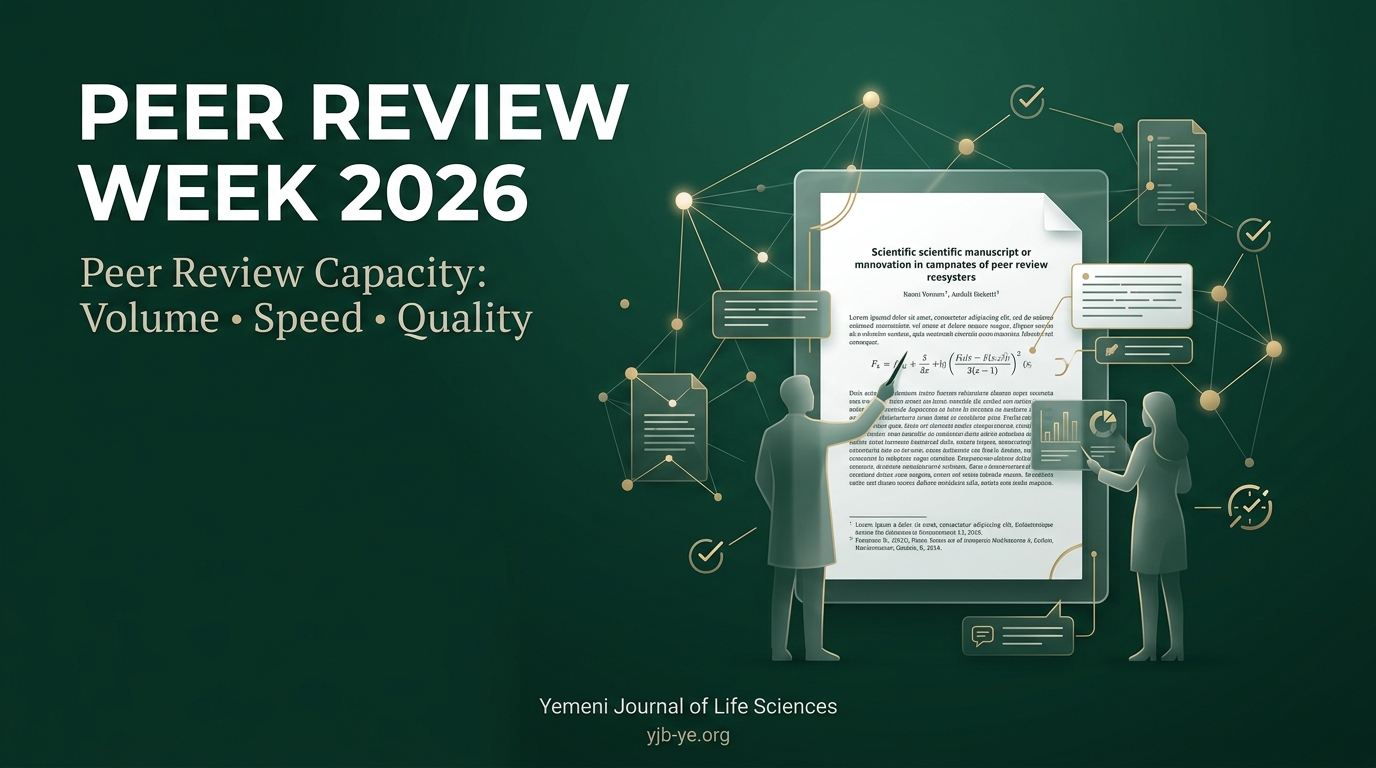
The Yemeni Journal of Life Sciences is joining the global scholarly publishing community in recognizing Peer Review Week 2026, taking place from 14–18 September 2026, under the theme:
Peer Review Capacity: Volume, Speed, and Quality
Peer Review Week is an annual global initiative that brings together researchers, peer reviewers, editors, publishers, scholarly societies, librarians, and other members of the research and scholarly communication community to recognize the importance of peer review and discuss developments, challenges, and opportunities within the peer-review system.
The 2026 theme addresses an increasingly important question in scholarly publishing: how can peer-review systems respond to growing submission volumes and expectations for timely decisions while maintaining the quality, fairness, integrity, and trust that underpin scholarly communication?
Recognizing the Contribution of Peer ReviewersPeer review is more than a procedural step between manuscript submission and publication. It is an important scholarly contribution through which researchers dedicate their time and expertise to evaluating manuscripts, identifying areas that require improvement, and providing constructive feedback that can strengthen scientific work.
For journals and editors, maintaining a reliable and diverse reviewer community is therefore essential. At the same time, reviewers face competing academic and professional responsibilities as the volume of scholarly publications continues to grow.
This creates an ongoing need for sustainable peer-review practices that value quality, rigor, fairness, and efficiency, without treating speed as a substitute for careful scholarly assessment.
Building Peer-Review Capacity in Emerging Research CommunitiesFor emerging research communities, strengthening peer-review capacity has an additional dimension.
Developing a pool of qualified reviewers requires opportunities for researchers—particularly early-career researchers and postgraduate researchers—to understand the principles, responsibilities, and ethical requirements of peer review and to develop practical reviewing skills.
Capacity-building efforts may include:
- Developing researchers' understanding of peer-review ethics and responsibilities.
- Encouraging constructive and evidence-based reviewer comments.
- Improving awareness of confidentiality and conflicts of interest.
- Supporting early-career researchers in developing peer-review skills.
- Expanding reviewer networks across institutions, disciplines, and geographical regions.
- Recognizing the scholarly contribution of peer reviewers.
- Promoting responsible use of emerging technologies, including artificial intelligence, while preserving appropriate human scholarly judgment.
Such efforts can contribute to a stronger, more inclusive, and more sustainable research ecosystem.
The Role of the Yemeni Journal of Life SciencesAs a Diamond Open Access journal, the Yemeni Journal of Life Sciences recognizes rigorous peer review as an essential component of responsible scholarly publishing.
The journal is committed to supporting a peer-review process that is rigorous, constructive, ethical, fair, confidential, and focused on improving the quality of scholarly work.
The journal also recognizes that strengthening peer-review capacity is not solely the responsibility of individual journals. It is a shared responsibility involving researchers, reviewers, editors, universities, scholarly organizations, publishers, and the wider research community.
For emerging research environments, strengthening this capacity can help researchers participate more actively in international scholarly communication—not only as authors, but also as reviewers and contributors to the quality-assurance processes of academic publishing.
Looking Beyond Peer Review WeekPeer Review Week provides an opportunity to recognize the contribution of peer reviewers and discuss the future of peer review, but these discussions extend beyond a single week.
Sustainable peer review requires continued attention to reviewer development, ethical standards, recognition, diversity, workload, editorial practices, and the responsible use of technological tools.
The Yemeni Journal of Life Sciences welcomes the opportunity to contribute to this broader scholarly conversation and to encourage researchers and reviewers in Yemen and beyond to engage with discussions about the future of peer review.
About Peer Review Week 2026Peer Review Week 2026 takes place from 14–18 September 2026 under the theme:
Peer Review Capacity: Volume, Speed, and Quality
The initiative brings together members of the global scholarly communication community through articles, webinars, discussions, interviews, educational activities, and other contributions related to peer review.
Learn more about Peer Review Week 2026:
Official Peer Review Week website
Researchers, reviewers, editors, and members of the scholarly publishing community can follow discussions surrounding Peer Review Week 2026 through:
#PeerReviewWeek #PRW2026 #PeerReview #ScholarlyPublishing #ResearchIntegrity
Continue ExploringReviewer Guidelines
Learn about reviewer responsibilities, confidentiality, conflicts of interest, and the journal's peer-review process.
Become a Reviewer
Join the Yemeni Journal of Life Sciences Reviewer Network and contribute your expertise to the peer-review process.
About the Journal
Learn more about the journal's aims, scope, publishing model, and editorial structure.
Current Issue
Explore the latest peer-reviewed research published by the journal.
The Yemeni Journal of Life Sciences is an international, peer-reviewed, open-access scientific journal dedicated to publishing high-quality research across the life sciences.
The journal is committed to scientific integrity, rigorous peer review, editorial excellence, and the responsible dissemination of scholarly knowledge.
The journal operates under a Diamond Open Access model, with no article processing charges (APCs) for authors and free access to published research for readers.
Published by
Yemeni Journal of Life Sciences Editorial Office